Mildest
Winter
December to February
Read moreYour own checklist
The quick version
The best month to go to Fuerteventura depends on your plan, because August is the warmest and driest at 27.9 °C while January is the mildest at 20.8 °C.
Best months in brief
Checklist · 9 tasks
Tap to check items off; your progress is remembered on this device.
0 / 9 ready
All ticked. Pick your date for the Cofete track, and the rest is settled.
Save a placeHighs, lows, rain and daylight for every month from the airport weather record, how the trade winds change the island and which month suits your plans, from beaches to stargazing.
Editorial team, fuerteventuratour.click · Updated November 23, 2026 · Takes 9 min
Quick look
People who ask when to visit Fuerteventura want a single month, and the sensible reply is a short one, but the honest answer is that the island has no bad one. The tourism site calls the climate balmy and mild, with few swings, so that the island can be visited 365 days a year.3 What changes through the year is the wind, the length of the day and the small amount of rain, so the best month is the one that matches the plan you have in mind.
The numbers below come from the weather station at Fuerteventura airport, on the east side of the island, in a record that averages 1991 to 2020. August is the hottest month: highs average 27.9 °C by day and 21.9 °C by night.1 January is the coolest, at 20.8 °C by day and 14.9 °C by night.1 Between those months the difference is small for a beach island, which is why the choice is about wind and light as much as about heat, and why a winter visit still works for anyone who packs a layer.
French-speaking visitors get the same answer in a few lines: go in any month, pick spring or autumn for walking and sightseeing, pick summer for the driest days and pick winter for the mildest ones. The sections below take each season in turn, with the figures for every month in a table, and the checklist at the top lists what to settle before you book.
The record
| Month | Daily high and low | Rain | Daylight |
|---|---|---|---|
| January | 20.8 °C and 14.9 °C1 | 13 mm1 | 10.5 hrs1 |
| February | 21.1 °C and 14.9 °C1 | 10 mm1 | 11.2 hrs1 |
| March | 22.2 °C and 15.5 °C1 | 10 mm1 | 12 hrs1 |
| April | 23.1 °C and 16.4 °C1 | 5 mm1 | 12.8 hrs1 |
| May | 24.7 °C and 17.7 °C1 | 1 mm1 | 13.5 hrs1 |
| June | 26.2 °C and 19.5 °C1 | 0 mm1 | 13.9 hrs1 |
| July | 27.5 °C and 21.1 °C1 | 0 mm1 | 13.8 hrs1 |
| August | 27.9 °C and 21.9 °C1 | 0 mm1 | 13.2 hrs1 |
| September | 27.5 °C and 21.5 °C1 | 2 mm1 | 12.4 hrs1 |
| October | 26.4 °C and 20.2 °C1 | 11 mm1 | 11.5 hrs1 |
| November | 24.2 °C and 18 °C1 | 13 mm1 | 10.8 hrs1 |
| December | 22.1 °C and 16.1 °C1 | 21 mm1 | 10.4 hrs1 |
Averages for 1991 to 2020 at the airport station on the east side of the island, with sun above the horizon at mid-month.1
December to February is the mild part of the year. December's highs average 22.1 °C, January's 20.8 °C and February's 21.1 °C, while the lows fall to 16.1 °C, 14.9 °C and 14.9 °C.1,1,1 It is not beach weather for everyone, but it is comfortable for the walks to Calderón Hondo, which the tourism site lists as a walk for every month of the year.4 Pack long trousers and a light jacket for the first hour of the day, and expect the warmth to arrive by late morning.
Winter is also the rainiest season, which on this island means little. December records 21 mm of rain, January 13 mm and February 10 mm, and a day with 2.5 mm or more is rare, at 1 or 2 days a month.1,1,1 Days are short, with 10.4 hours of daylight in mid-December and 10.5 hours in January.1,1 The tourism site gives winter sunrise at 7:30 am and sunset at 6:30 pm, so plan boat trips and walks for the middle of the day.5
Winter has one real advantage for the night sky. The tourism site says the skies looking south from the Tefía observatory are particularly pretty in the first months of the year, with Sirius and Canopus visible.6 A guided stargazing tour at the Calderón Hondo volcano starts from €46, runs 3 hours and asks you to book at least 3 days ahead so the weather can be checked. A jacket matters on a volcano at night, and the listing recommends one along with comfortable shoes.
Month by month
The chart plots hours with no sun (mid-month) and days that get at least 2.5 mm of precipitation. Data: NOAA, station Fuerteventura Airport (NOAA station FUERTEVENTURA/AEROPUERTO, 12 months of temperatures and rainfall), 1991 to 2020.1
March to May is when the island warms up. Daily highs average 22.2 °C in March, 23.1 °C in April and 24.7 °C in May, while rain falls from 10 mm to 5 mm and then 1 mm.1,1,1 Daylight stretches from 12 hours in mid-March to 13.5 hours in mid-May, which gives long, easy afternoons for sightseeing.1,1 This is a good season for the walking and museum side of the island, from Betancuria to the Ajuy caves.
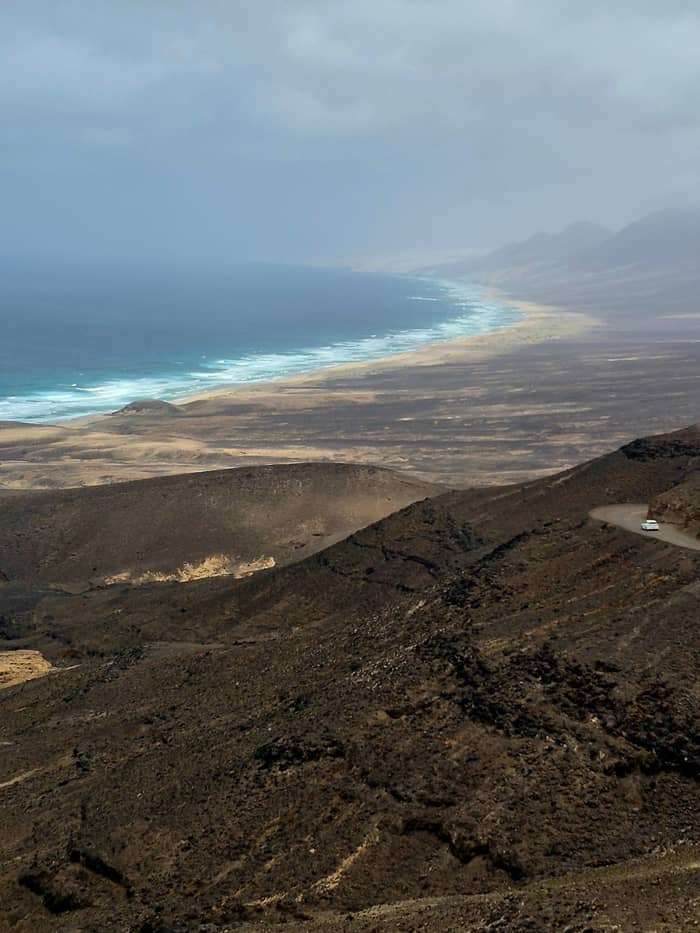
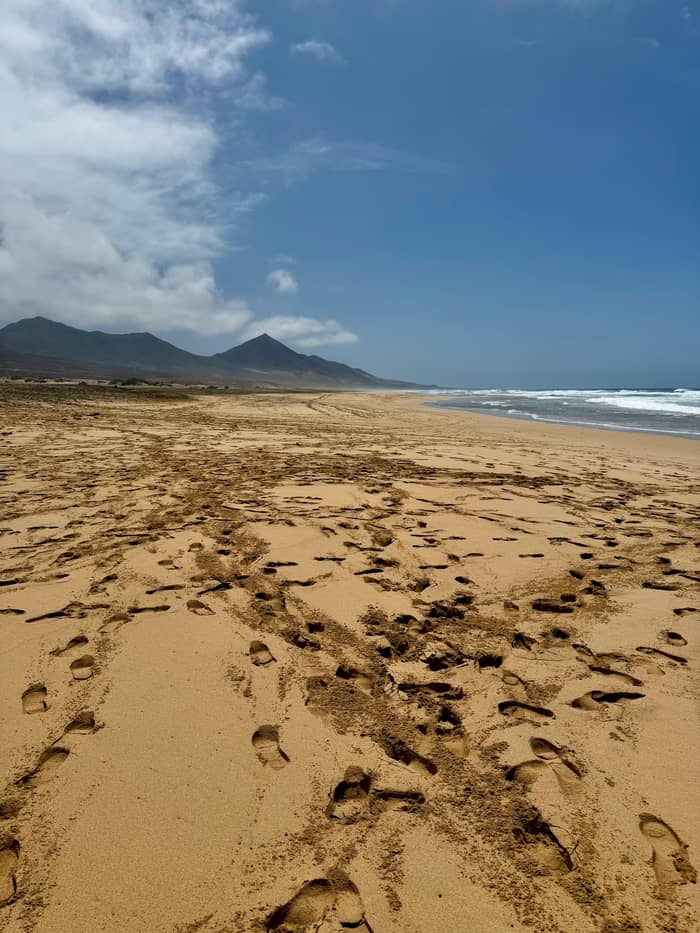
Spring is also when the wind builds. The tourism site says the trade winds, mainly from the north, give optimal conditions for windsurfing and kitesurfing, especially in the spring and summer months.2 If you plan a boat trip or a day on an exposed beach, expect a breeze, and carry a layer for the windward coast around Cofete, which the education wiki describes as windy with strong waves.7
The wind is not a drawback for every plan. Windsurfers choose the island because of a magical combination of wind and warm temperatures, and the tourism site says that makes it a place to practice the sport at any time of year.8 For everyone else, spring offers an easy middle path: no summer heat, little rain and days that already run past 12 hours of daylight, which suits a full day of sightseeing without a long siesta.1,1
Pick your month
Name your priority and the months that suit it come first.
If I want the warmest days
August
It has the hottest average daily high of the year, 27.9 °C, and no rain at all.1
If I want the driest weeks
June to August
If I want cool days for walking
January to March
Highs run from 20.8 °C to 22.2 °C, comfortable for the crater walk, which has a listed best season of every month.1,1,4
If I want to windsurf or kite
Spring and summer
The trade winds are strongest in the spring and summer months.2
If I want clear night skies
Early in the year
The skies from Tefía are particularly pretty in the first months of the year.6
If I want the longest evenings
June
Mid-June has 13.9 hours of daylight, the longest day in the record.1
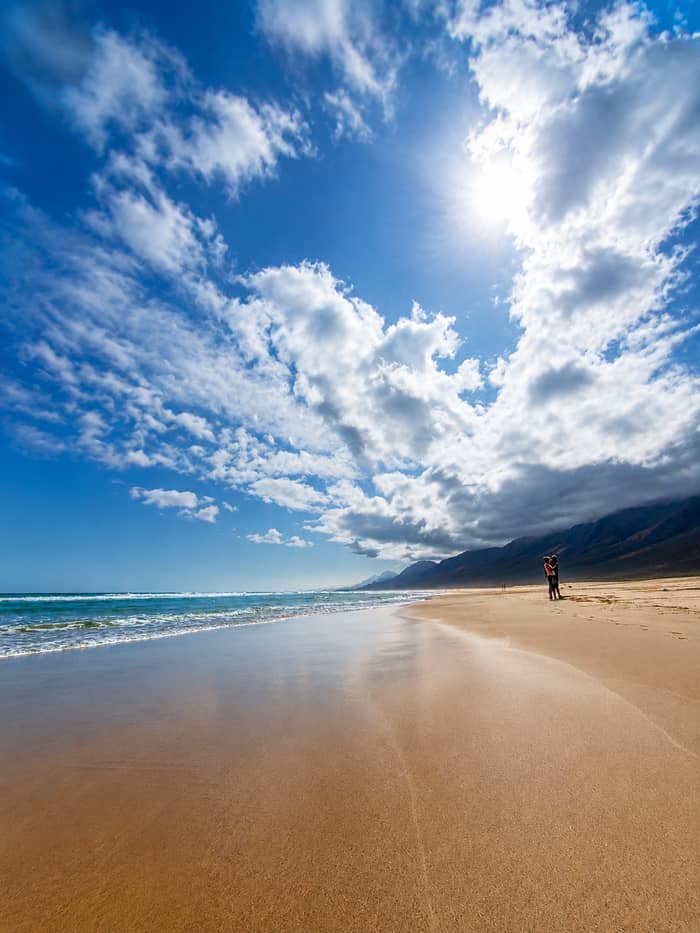
June to August are the driest and the hottest months, with no rain at all in the record. Average daily highs reach 26.2 °C in June, 27.5 °C in July and 27.9 °C in August, with lows of 19.5 °C, 21.1 °C and 21.9 °C.1,1,1 Rain is 0 mm in each of those months, and 0 days reach 2.5 mm.1,1,1 If you want to swim and sunbathe in a settled pattern, this is the season, and the tours that depend on a calm sea or an open road are least likely to be disturbed.
The day is long. Mid-June brings 13.9 hours of daylight and mid-July 13.8 hours, which leaves room for a late afternoon excursion and a long dinner outdoors.1,1 The tourism site gives summer sunrise at 7:00 am and sunset at 8:30 pm, which leaves a late, soft evening for dinner after a boat day or a beach walk.5 Sunshine is plentiful, since the archipelago is among the sunniest parts of Europe with over 3,000 hours, and the sun protection advice is not decoration.12
The site's sun advice is to reapply cream every 2 hours and after swimming, and to stay out of direct sun from noon to 4 pm.9,13 Plan Cofete, Lobos and the dunes for the morning, before the sun is high and the hours of strongest sun are still ahead. The Lobos restaurant needs a reservation, as the islet limits its visitors, so book the table before you book the ferry back.11 A summer day on the islet is easy to enjoy if you arrive early, walk first and eat when the heat peaks.
Price the plan
Enter your group size to see what the year-round tours cost from, side by side.
Compare 4 choices
Enter your group size to see what the year-round tours cost from, side by side.
≈
View≈
View≈
View≈
ViewStarting prices on GetYourGuide, exchanged at the ECB reference rate. The booking page gives the exact price.
Through the year
December to February
Highs of 20.8 °C to 22.1 °C and rain between 10 mm and 21 mm.1,1,1
March to May
Highs rising from 22.2 °C to 24.7 °C, with rain falling to 1 mm.1,1
June to August
No rain and highs of 26.2 °C to 27.9 °C, with 13.9 hours of daylight in June.1,1
September to November
Highs from 27.5 °C down to 24.2 °C and rain of 2 mm to 13 mm.1,1
September to November keep the summer's warmth and bring back a little rain. Daily highs average 27.5 °C in September, 26.4 °C in October and 24.2 °C in November, and the lows fall from 21.5 °C to 20.2 °C and 18 °C.1,1,1 Rain returns slowly, at 2 mm in September, 11 mm in October and 13 mm in November.1,1,1 September keeps the summer's heat with the first hint of change, and it is a good compromise for anyone who wants warm sea air without the driest stretch of the year.
Autumn is also olive time. Visitors can follow the olive crop with several companies and sample the oils, and the harvest begins in August and ends with October.14,15 A farm visit pairs well with a stop at a cheese dairy. That fits the food and walking tours covered on the tapas, wine and walking page of this guide, and it makes a visit to a mill, a cheese dairy or an olive farm a natural autumn plan.
The light fades fast: 12.4 hours of daylight in mid-September, then 11.5 in October and 10.8 in November.1,1,1 That shift matters for planning because the tours that run past late afternoon lose light earlier each week. Check the exact pickup time, which the Cofete jeep listing says is sent the day before. November is a comfortable month for walkers, with the highs close to those of March, and the island has the room to itself for longer walks inland.1,1
Video
Nomad Brothers on YouTube · Nothing is fetched until you hit play.
balmy and mild, with few oscillations, which makes it accessible 365 days a year
Besides temperature, a good day on this island depends on the wind and on the calima, a warm, dusty air mass that the island council traces to the Sahara.16 The wind is the more familiar of these forces, and the calima the less predictable. A calima day can dull the views and make a long drive less pleasant, so keep the schedule flexible when the sky turns hazy, and move the viewpoints to another day if the haze is thick. Photographs taken in the haze look flat, so the extra day costs little.
The road to Cofete is the one place where weather can cancel a plan. One Cofete listing says bad weather can close the road to the beach. The stargazing listing is stricter: it gives no refund when the stars stay hidden by the weather. Both are good reasons to book a month when the forecast is settled, and to keep a flexible date when it is not, so that a closed road or a cloudy night does not cost you the fare.
Cancellation terms help here. The listings for the Cofete jeep safari and the panoramic tour can both be cancelled up to a day before the start for a full refund. A dry, settled month such as August almost removes the issue, while winter and early spring ask for a little more flexibility. Whatever the month, treat the Atlantic at Cofete with the utmost respect, as the tourism site advises, and keep swimming for the sheltered beaches.10
Pack for sun and wind in every month. Choose a cream suited to your skin and reapply it every 2 hours, and add a sunshade for long hours on the sand.9 A light layer for the evening matters more than a heavy one, because the lowest average low of the year is 14.9 °C.1,1 A hat, sunglasses and a scarf for the wind complete the list, and a small day bag makes it easy to carry water between stops.
For booking, the main question is whether to fix the date early. Popular days out, such as the Cofete jeep safari from €66, carry free cancellation until a day before, which lets you settle the date once the forecast is clear. Boat trips and the Lobos ferry are covered on other pages of this guide, where each fare and sailing length is compared, and the Oasis park ticket starts from €42 with the same free cancellation.
If you are choosing the month for the tours rather than the beach, a few simple rules help. Choose summer for settled sea days and long evenings, spring for the island's interior and its walks, autumn for the olive harvest and gentler heat and winter for the clearest night skies. The airport record shows that no month is outside what a visitor can enjoy, only outside what a particular plan needs.3 French-speaking visitors who search for Fuerteventura quand partir can use the same checklist.
FAQ
Windsurfing and kitesurfing conditions peak in the spring and summer months, says the tourism site, thanks to the trade winds from the north.2
The tourism site says the skies from Tefía are particularly pretty in the first months of the year, and the volcano tour starts from €46.6
One listing says bad weather can close the Cofete road, so book with free cancellation.
Sources
Planning Cofete or a boat day on Fuerteventura? Ask a real person here.